Fraud, Waste, and Abuse in Healthcare
30% of US Healthcare spending is lost to Fraud, Waste, and Abuse.A1
Fraud, Waste, and Abuse (FWA) is a challenge in every industry.
In healthcare, FWA leads to significant financial losses, estimated to cost the U.S. healthcare system billions of dollars annually.
This misuse of resources drives up healthcare costs and impacts the quality of care that patients receive.
Our research in 2024 explores identifying the size of FWA in Healthcare, setting a common vocabulary of definitions and categories, and potential solutions.
We looked into FWA a decade ago. Sadly, there is still no national effort on tracking with rigor, and little publically reported data.
What is Fraud, Waste, and Abuse?
Crafting a common definition
Healthcare organizations have varying definitions of FWA. We've taken the FWA definition from several organizations and have distilled each into a single sentence.
Fraud: intentional misuse of healthcare system resources.
Waste: unintentional misuse of healthcare system resources.
Abuse: misuse of healthcare system resources independent of intention.
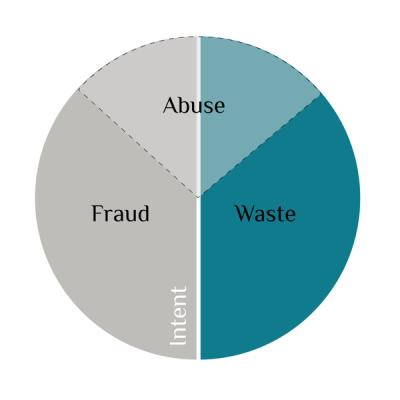
Based on these definitions, the focus is on the intent to determine Fraud or Waste. While Abuse becomes the umbrella for all misuse of healthcare resources regardless of intent.
The Cost of FWA, $1 Trillion
Estimating FWA
Finding the total amount of Fraud, Waste, and Abuse is a challenge. In our research, we found an estimate of 10% fraud and 20% waste, totaling 30%.A1 While the data below is from 2009, today in 2024, it is still the most recent estimate of total FWA in US Healthcare.
30 percent of U.S. health spending (public and private) in 2009 — roughly $750 billion — was wasted on unnecessary services, excessive administrative costs, fraud, and other problems.5
United States Department of Health and Human Services (HHS)
30% FWA
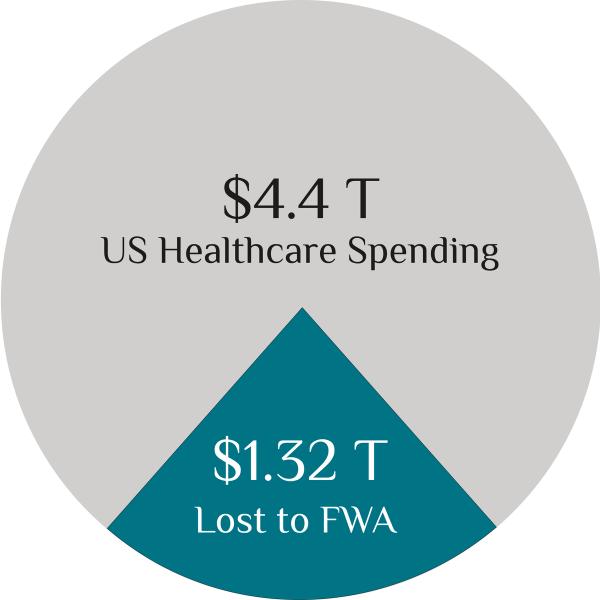
Fraud 10% + Waste 20% A2
Estimates of fraudulent billings to health care programs, both public and private, are estimated between 3 and 10 percent of total health care expenditures.3
Federal Bureau of Investigation (FBI)
Recovering FWA
For every $1 Invested, $4 Recovered
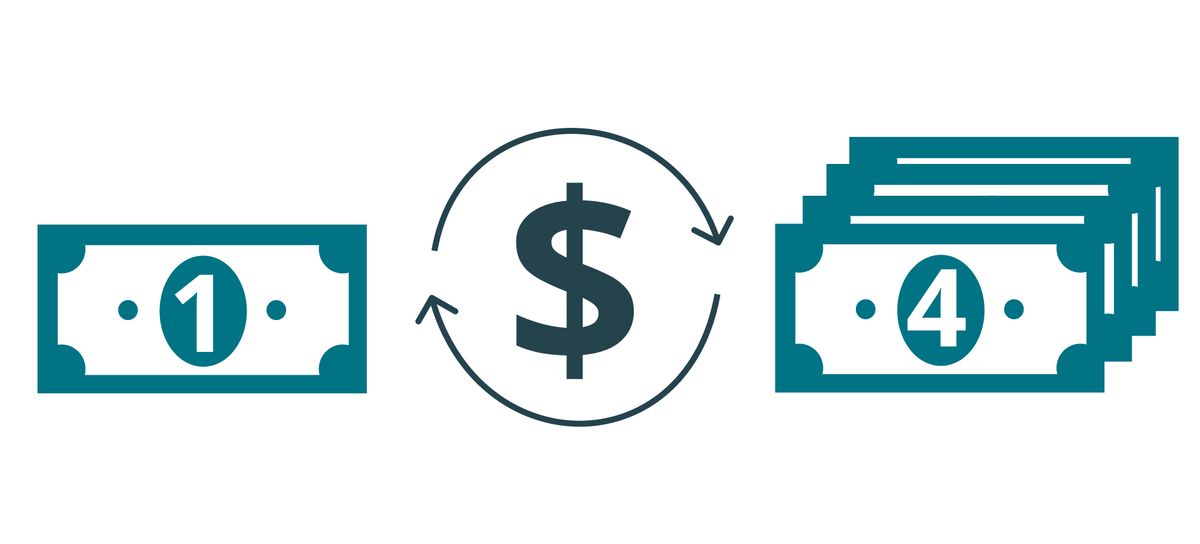
The Department of Health and Human Services (HHS) and the Department of Justice (DOJ) have a joint Health Care Fraud and Abuse Control (HCFAC) Program. The HCFAC protects consumers and taxpayers by combating healthcare fraud.
Below, we can look deeper into FY2021 spending and recovery.
While FY2021 was on the lower end of success during the three year rolling average, the HCFAC made $0.9B from their efforts. Only 0.14% of loss to fraud, waste, and abuse was recovered, leaving tons of money intended for healthcare use unrecovered. The $0.9B success, paired with the low 0.026% of US Healthcare spending allocated to the HCFAC for recovery efforts, makes us question why not invest more?
Proposed Solutions
Concept 1: Health Accuracy Receipt
The Health Accuracy Receipt uses the patient as the fraud detection system.
The receipt is sent to patients after an encounter to confirm what happened during their visit.
It makes reporting fraud, waste, and abuse available to anyone.
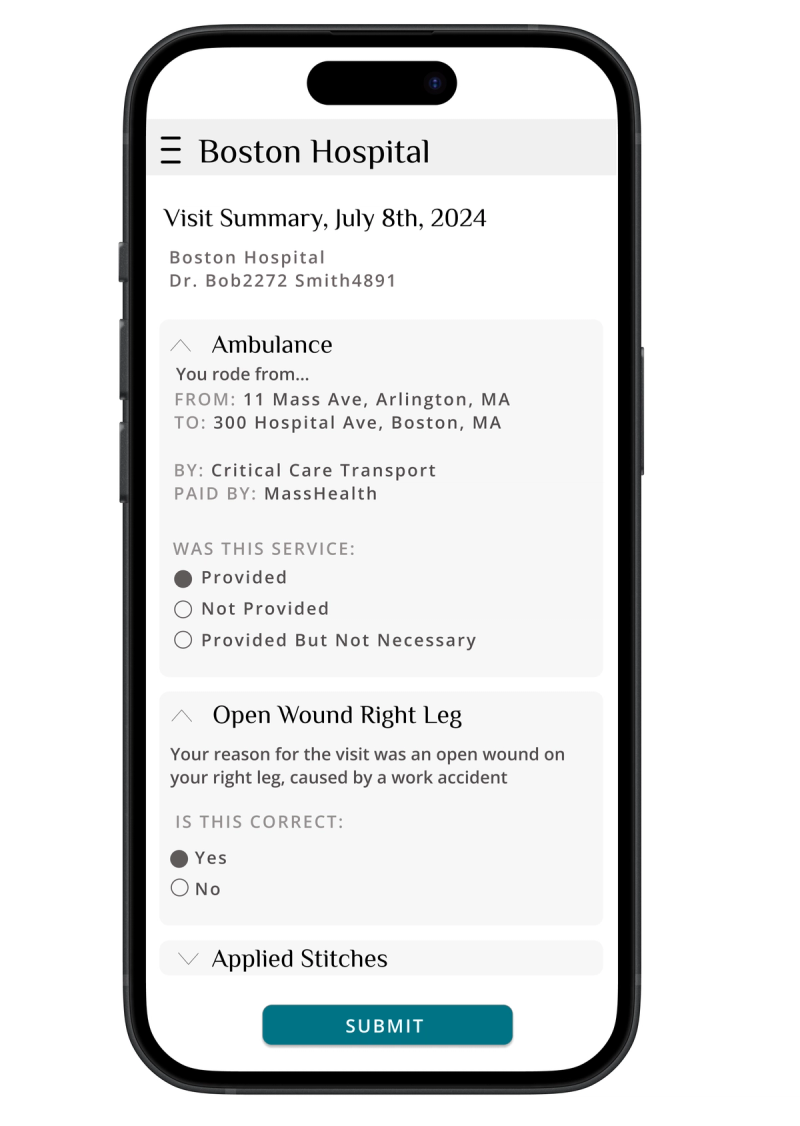
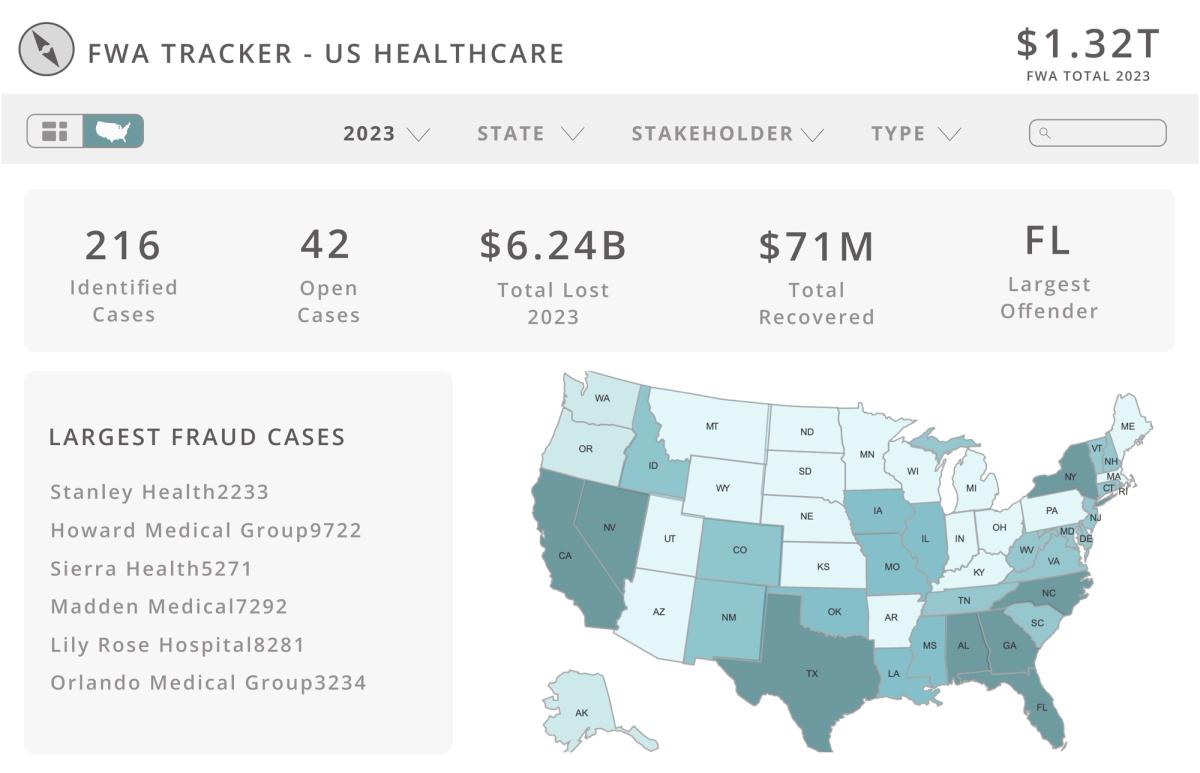
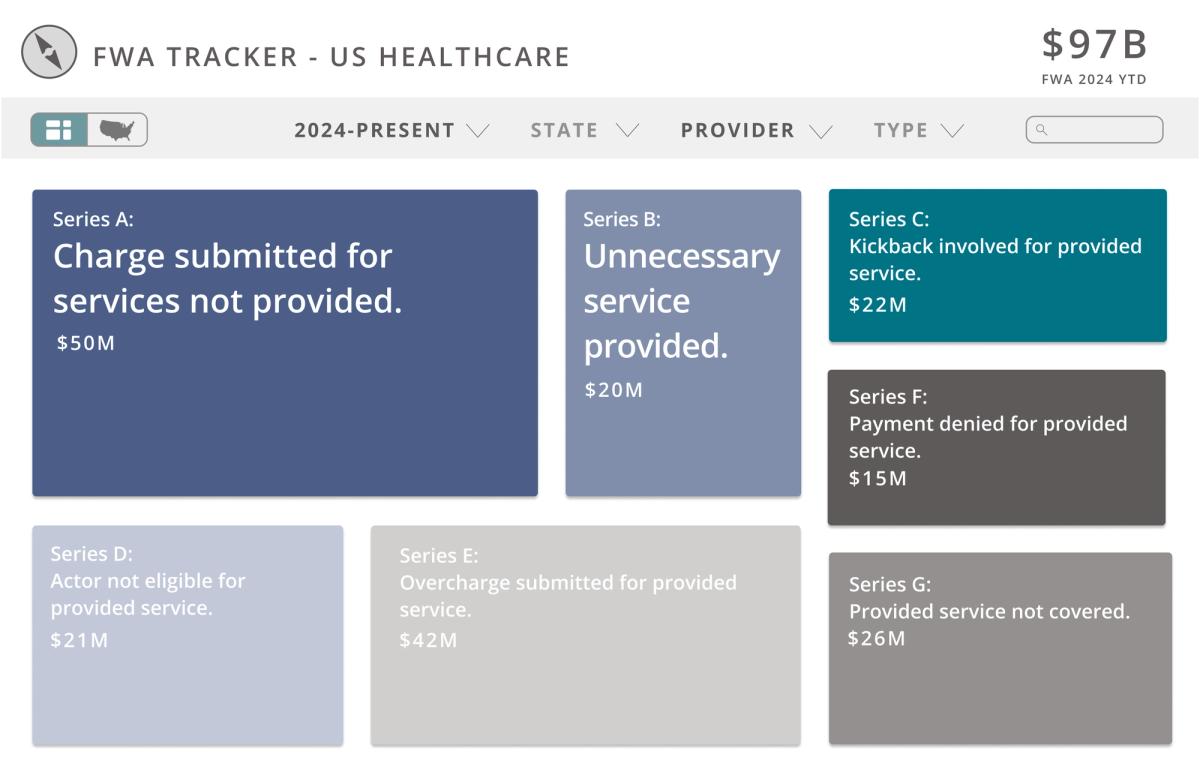
Concept 2: FWA Tracker
The FWA Tracker is a real-time fraud, waste, and abuse detection dashboard. It is built from a database which collects data from numerous sources, such as the Health Accuracy Receipt.
Methodology
Below is a description of the methodology used in creating the Fraud, Waste, and Abuse in US Healthcare report. Calculations are based on expert estimates, therefore final percentages are an estimate and should not be viewed as absolute numbers.
v1 - 1.Jul.2024
Calculations
Authors

Michelle Bourdon, GoInvo
Michelle is a designer and developer with a background in computer science, business, and healthcare. She is currently working towards a BS in Computer Science at the University of Western Ontario (UWO). Michelle joined GoInvo as an intern in 2024.

Eric Benoit, GoInvo
Eric Benoit is the Creative Director of GoInvo, leading the studio’s UX creation process from concept to production. Eric works as an interaction designer, experience designer, and information architect, designing better products by thoroughly understanding user behaviors, expectations, and goals. Eric’s background and love for design in the context of human experience helps him transform complex information systems in healthcare and the enterprise into responsive and adaptive human-centered designs.

Juhan Sonin, GoInvo
Juhan Sonin leads GoInvo with expertise in healthcare design and system engineering. He’s spent time at Apple, the National Center for Supercomputing Applications (NCSA), and MITRE. His work has been recognized by the New York Times, BBC, and National Public Radio (NPR) and published in The Journal of Participatory Medicine and The Lancet. He currently lectures on design and engineering at MIT.
Contributors
Edwin Choi, GoInvo
Anesu Machoko, MetaDigital
Philip Mattera, Good Jobs First
Siobhan Standaert, Good Jobs First
Jung Hoon Son, Clinicians.fyi
References
- 1.American Medical Association. Trends in health care spending. Published April 25, 2024. Accessed June 18, 2024: https://www.ama-assn.org/about/research/trends-health-care-spending
- 2.Peterson Foundation. Almost 25% of Healthcare Spending is Considered Wasteful. Published April 3, 2023. Accessed June 18, 2024: https://www.pgpf.org/blog/2023/04/almost-25-percent-of-healthcare-spending-is-considered-wasteful-heres-why
- 3.National Health Care Anti-Fraud Association. Testimony of the National Health Care Anti-Fraud Association to the House of Insurance Committee. Published January 28, 2010. Accessed June 18, 2024: https://www.kff.org/wp-content/uploads/sites/3/2011/12/2010_0017_0014_tstmny.pdf
- 4.US Department of Justice, US Department of Health and Human Services. Annual Report of the Departments of Health and Human Services and Justice. Published July, 2022. Accessed June 18, 2024: https://oig.hhs.gov/documents/hcfac/1177/OIG-HCFAC-2021-Complete%20Report.pdf
- 5.US Department of Health and Human Services. Management Challenge 2: Fighting Fraud, Waste, and Abuse in Medicare Parts A and B. Published March, 2015. Accessed June 18, 2024: https://github.com/goinvo/fraud-waste-abuse/blob/main/estimate-of-fwa-in-medicaid.pdf